China, with its staggering economic growth and vast consumer base, has become the gold mine for businesses worldwide. But as many Western entrepreneurs have discovered, navigating the Chinese market is not for the faint-hearted. To help you steer through these dynamic waters, here’s a concise guide to prioritize your efforts when expanding or growing your business in China.
1. Dive Deep with Market Research and Localization:
Chinese consumers have their unique preferences, and a one-size-fits-all approach won’t cut it here. Conduct thorough market research. Understand what appeals to the local demographic. Remember, localizing your product or service isn’t just translating it; it’s about making it resonate with Chinese culture, traditions, and values.
2. Navigate the Regulatory Maze:
China’s regulatory landscape can be a minefield. However, it’s essential to understand the ins and outs of local regulations and stay compliant. Don’t forget to safeguard your intellectual property, as IP concerns are more pronounced in China.
3. Embrace China’s Digital Giants:
Say goodbye to Facebook and Google, and say hello to WeChat, Alipay, and Douyin! Your digital marketing strategies must pivot around China’s unique platforms. Get acquainted, get comfortable.
4. Find Your Local Partner:
Consider forming joint ventures with local businesses. They often provide invaluable insights into the market, help in navigating the regulatory environment, and lend credibility to your brand.
5. Savor the Cultural Soup:
From the significance of color red to the importance of Lunar New Year, understanding Chinese cultural nuances can be a game-changer. This knowledge can influence your marketing campaigns, product launches, and even business negotiations.
6. Tap into E-commerce and Mobile Payments:
Mobile is king in China. Platforms like Taobao and Tmall drive sales, while mobile payments like WeChat Pay and Alipay are omnipresent. If you’re in retail, understanding and leveraging these platforms can offer a significant edge.
7. Be Ready for Fierce Competition:
The Chinese market is saturated, and local brands have an in-depth understanding of their turf. Your value proposition needs to be crystal clear and compelling to make a mark.
8. Cultivate Government Relations:
Having friends in high places can be especially beneficial in China. While this may be different from Western business norms, fostering relationships with local and national government entities can open doors.
9. Streamline Your Supply Chain:
China is geographically diverse. Make sure you have a grasp of the local logistics and supply chains, especially if you’re dealing in tangible goods.
10. Build and Retain a Stellar Team:
Your team is your biggest asset. Understand local compensation trends, workplace expectations, and cultural nuances when hiring and retaining talent.
In closing, while the opportunities in China are immense, so are the challenges. But with the right strategy, diligent research, and a bit of cultural acumen, Western entrepreneurs can truly thrive in the Middle Kingdom.
If you’re already making strides in China or are contemplating the leap, I’d love to hear your experiences and thoughts. Here’s to your success in the Dragon’s den! 🐉🚀
For any question, please send an email to gracecoachconsult@gmail.com
1. Brand Partnerships & Sponsored Posts: Partner with businesses and brands that are trying to tap into the Chinese market or offer products/services tailored for that audience. They might pay for you to promote their products or services.
2. Affiliate Marketing: Share products related to China’s business trends or tech products and earn a commission for every sale made through your link. Websites like Amazon offer affiliate programs that you can use.
3. Offer Courses/Workshops: If you’re knowledgeable about China’s business landscape or tech scene, you can offer online courses or workshops. Use platforms like Teachable, Udemy, or even Zoom to host these classes.
4. Paid Consultation Services: Offer paid consultation sessions for businesses or individuals looking to understand or penetrate the Chinese market. Share insights on cultural nuances, business etiquette, or marketing strategies specific to China.
5. Digital Products: Create and sell e-books, reports, or other digital resources that provide insights into China’s business culture, technological advancements, or general trends.
6. Merchandise Sales: Launch a merchandise line with designs or slogans that resonate with your audience. This can be anything from T-shirts to mugs, centered around Chinese tech and business culture.
7. TikTok’s Creator Fund: Depending on your location and eligibility, TikTok’s Creator Fund directly pays creators for their content based on various factors, including engagement and view count.
8. Subscription Services: Utilize platforms like Patreon where fans can support you by subscribing to exclusive content related to deeper insights, behind-the-scenes content, or special analyses on Chinese business trends.
9. Host Webinars: Webinars can be a more interactive alternative to courses. Host sessions on specific topics, like “The Future of Tech in China” or “Understanding Chinese Consumers.”
10. License Your Content: If you create original, high-quality content, media outlets or educational platforms might be interested in licensing your videos for their use.
🚀🤖 Chinese AI on the Rise: A New Technological & Industrial Revolution! 🌐💡
Exciting times ahead, as China’s major tech heavyweights are accelerating their efforts to develop AI-powered large models, like ChatGPT! This cutting-edge technology is expected to free us from tedious tasks, enabling us to focus on creative thinking 🎨🧠, with immense potential in fields like culture, retail, finance, healthcare, and education 🏥📚💼.
AI’s penetration rate is projected to reach a staggering 20% by 2026, revolutionizing industries such as meteorology, oceanography, agriculture, machinery, aviation, aerospace, and geology 🌦️🌊🚜✈️🛰️.
Giants like Huawei, JD, Alibaba, Baidu, and NetEase are all joining the AI chatbot race 🏁, setting the stage for massive growth in the AI-generated content sector in China.
But as we embrace this incredible technology, let’s not forget the challenges that come with it, such as ethical dilemmas, privacy leakage, and data security 🔐🛡️. We must ensure responsible use and adherence to laws and regulations to unlock AI’s full potential in a secure and ethical manner.
What do you think about China’s rapid advancements in AI? How will this impact the global AI landscape? Share your thoughts in the comments below! 👇🌍
China’s new economy is divided into “two decades preceding and following.”
The first two decades are from 2000 to 2019. The largest industrial chain and second-largest consumer market in the world have been created during this time thanks to China’s GDP, which has multiplied nine times. The launch of China’s new economy was enabled by the mega-scale market and industry.
The rise of consumer Internet platforms was the most significant result of China’s new economy in the first two decades. Because China has such a large market, a platform simply uses financial capital to support its continuous expansion, eventually achieving a monopoly position, aiming for a future monopoly, discounting it into a huge net present value (NPV) in the present, and then using this NPV as a valuation to help it achieve a monopoly. This is the closed-loop financial development model of consumer Internet platforms, and as a result, China has produced a number of world-class Internet giants.
However, in terms of technological development, a foreign think tank scholar conducted a study to determine each country’s position on the “smile curve.” According to her research, from 2000 to 2019, China’s economic industry, although the scale has increased significantly, has remained in the middle position, that is, manufacturing, assembly, compared to the two ends of the R&D, sales, the value added is relatively low.
However, China has achieved industrial upgrading in a few areas, including high-speed rail, new energy, 5G, and so on. Even so, these high-tech industries with high R&D investment are led by government departments, and the government is either an investor or a major customer. The venture capital and startups are not heavily involved.
So, in his speech last year, General Secretary Xi Jinping stated that the new round of scientific and technological revolutions and industrial change has provided a strong impetus to economic development, but has also had a profound impact on employment and income distribution, including some negative consequences that must be effectively addressed and resolved.
The first two decades of China’s new economy were essentially “capital leveraged the country“.
The consumer Internet is primarily based on business model innovation, with little technical content. The QR code, for example, which we commonly scan, was actually invented in the 1990s. It has grown so fast because it can capitalize on the maximum positive external benefits generated by the country during the development process, such as increased disposable income for our residents, improved logistics and transportation, and popularization of information technology, all of which are done by the state rather than venture capitalists and entrepreneurs.
However, the state bears the negative externalities of this capital-driven, winner-take-all development model, resulting in the emergence of “Gilded Age” problems throughout society, such as the widening income gap, the lack of social security for delivery riders, and the socio-economic problems caused by these monopolies, all of which must be paid for by the state.
As a result, the central government has proposed “high-quality development”, “common prosperity” to promote healthy economic growth, optimize the distribution structure, create opportunities for more people to become wealthy, and avoid “in-rolling” and “lying flat. This is a significant turnaround and an important opportunity for China’s new economy, as well as the start of China’s new economy’s next twenty years.
It should be “country leverages capital” in the next 20 years of China’s new economy.
Under the leadership of the national strategy, China’s economy will be able to transition from large-scale development to high-quality development through capital-driven and industrial upgrading.
China should not only be large-scale, but also continue to move to the upper left of the smile curve. Moving up means increasing the industry’s value-added, which will result in more high-skilled jobs and higher per capita income, while empowering with technology to achieve cost reduction and efficiency and maintain Chinese manufacturing’s global competitiveness. At the same time, China’s position must shift to the left, that is, it must improve its R&D capabilities in order to solve strangleholds problem of key technologies.
Our investment in the new development stage should be heavily focused on “high-quality development and shared benefits“. Our company focuses on three main lines:
The first, the transformation and optimization of the supply chain. China has the world’s largest industrial supply chain, but it is still relatively fragmented and generally lacks the ability to transform technology and information technology, leaving a massive value space to be explored.
The second is hard technology import substitution. For example, chips are China’s largest annual import amount of products because, following an epidemic global shortage of semiconductors and a significant drop in oil prices, China imported 350 billion worth of chips in 2020, more than doubling the second place of crude oil. Another example is medical equipment; China has a lot of drugs and medical devices that are dependent on high-priced imports; the space for domestic substitution is very large, and once localization is achieved, it can greatly reduce the burden of people going to the doctor.
The third is sustainable development. Now the world is trying to achieve carbon neutrality, China is very early in this layout, the investment is also the most. For example, photovoltaic power generation used to cost $100 per unit in foreign countries, but thanks to the continuous development of Chinese enterprises, the cost has now dropped to a few cents per unit, enabling for large-scale application. Similarly, Chinese-made electric vehicle (EV) batteries have significantly reduced the cost of EV production, explaining why EVs have grown so rapidly in recent years.
What kinds of businesses will thrive in China’s new economy over the next two decades?
Baibu, Daxiongxingzuo, BaiAoHeng, All of these companies have one thing in common:
they are all entrepreneurial, but through a key technology, they have leveraged a large scale industry and have quickly grown into leaders in their niche industries. Such a phenomenon is also found in other developed countries, a large-scale industrial chain, able to support hundreds of so-called “invisible champions”. China is the world’s largest producer, there must also be hundreds of “invisible champions”. Therefore, in the latter two decades of the new economy with high quality development, investors should not blindly pursue the financial-driven scale as before, but should focus on quality and develop a deeper understanding of the industrial chain and supply chain.
The preceding is my interpretation of China’s new economy, as well as some thoughts on future high-quality development. Finally, I’d like to share two guidelines with you that we should always keep in mind when making future investments.
The first point is to focus on the direction of common prosperity. The essential requirement of socialism with Chinese characteristics is common prosperity, and we should look for entrepreneurial opportunities that create universal value in our investments.
The second point is the General Secretary’s discussion of capital. Marx and Engels did not face the problem of large-scale capital at the time, and the Communist Party of China explored the establishment of a socialist market economy, leading the country to “cross the river by feeling the stones.” The pursuit of profit, the pursuit of return, which is engraved in the DNA of capital, is the most essential characteristic of capital. However, capital in China must consider two principles.
First, it should carefully balance its own investment return interests with national interests, and it should actively play the role of production factors.
Second, it must not pursue its own interests in ways that are detrimental to the country’s and people’s long-term interests.
There seems to be a lot of concerns about the China #economy and how geopolitics is affecting it.
The 🇨🇳 economy is transitioning towards a new development model. This is driven by China’s own national priorities with or without geopolitical considerations. The current geopolitical tensions are accelerating this process and also at the same time adding risks to this process.
China’s most important asset both for its own economic future and for its position in the world is its 𝗶𝗻𝗱𝘂𝘀𝘁𝗿𝗶𝗮𝗹 𝗰𝗮𝗽𝗮𝗰𝗶𝘁𝘆. China’s industrial capacity is bigger than the 🇺🇸 🇯🇵 🇩🇪 put together.
We make everything for the world but this capacity’s value is still relatively too low. We’ve been doing better of course. But overall our industrial capacities value still has much room to grow.
We make everything for the world but this capacity’s value is still relatively too low. We’ve been doing better of course, for instance the iPhone, 10 years ago only 3,5% of its value was created by China now it’s more than 25 %. But overall our industrial capacities value still has much room to grow.
To improve we need large-scale transformation of our industrial capacity so that it is enabled by technology, and also to build capacities in new industries such as those sectors driven by low carbon emissions.
China’s entire industrial capacity probably generates between 5 to 10 trillion US $ per year, 5 as industrial output and maybe 10 at the market endpoint. But the value-add of this capacity is still below 20%.
I would guess that our manufacturing generates perhaps 12 to 15 % gross margin, which is too low. Higher quality development would have it generate maybe 30 to 40 % gross margin. Now on such a large base this value increase would be enormous.
Semiconductors alone probably accounts for 5 to 10 points and we spend nearly half a trillion US $ importing semiconductor chips and related products.
This is more than crude oil and iron ore combined, as we know China is the largest crude oil and iron importer in human history.
China’s national priority going forward is not to chase mere the quantity of GDP growth but the quality.
The current geopolitical tensions make this process a national imperative. It’s now not just driven by economics but by national security.
In the next 10 years there will be tremendous investment and growth opportunities manufacturing, technologies, supply chain optimization, AI, semiconductors, life sciences and medical equipment, new alternative energy like EV and new materials.
All these makes the west particularly the U.S. feel threatened and insecure, and that’s understandable.
America sees its leadership position in technology innovation the bedrock of its global dominance. So they must compete.
But perhaps because their political system is inefficient and their society is polarized at the moment, they seem to feel they’re unable to compete effectively by improving their own national capabilities.
So they resort to geopolitical tactics to weaken its rival.
This adds significant risks to China’s path forward.
At the moment pessimism abounds about the Chinese economy, you know Covid lockdowns, real estate bubble, big tech blues, geopolitics, you name it, but these are short-term challenges.
Everyone faces short-term challenges; if not these, then something else will, but in the long run, I recommend that we refer to the 14th Five-Year Plan. It sets specific goals for a broad range of sectors manufacturing, technology, AI, semiconductors, Net-zero, R&D, and etc.
In the next 10 to 20 years, compared with the rest of the world China will be the continent of stability and growth.
Another key asset for China going forward in the future is political predictability. We know who will be in charge and what policies they will implement.
Don’t Bet Against the Five-Year Plan is a truism when it comes to investing in China.
On August 7, 2022, the annual “New Species Explosion – Wu Sheng Business Methodology Release 2022” kicked off. Wu Sheng, the proposer of Scene Methodology and founder of Scene Lab, released 8 methods and 5 forecasts of Scene Branding (SB) , systematically telling a “highly deterministic era of branding”.
The 6th New Species Explosion summarizes 8 methods ✅ of SB.
✅ 1️⃣ Trust relationship, with case studies from “Duku” and “Zhihu.” SB is a minimal model of trust relationship, a decentralized mechanism, and in-depth product, channel, and user operation. Wu shared a trend insight that pragmatic consumption is becoming the mainstream of consumption.
✅ 2️⃣ NFT spirit, with the case studies are “Bored Ape” and “Kuaishou”. SB is the super IP of digital consumption, NFT spirit, deepening the brand assets in the digital era. Wu believes that Bored Ape represents the new speed of digital popularity, and NFT spirit of quantifiable, distributable and traceable should become the digital belief of each brand.
✅ 3️⃣ Experience system, with the cases of “ARCFOX” and “Radish Run”. SB is a transgressive experience of digital life, designing experience systems to lead a differentiated life. Products should build their own experience system to become the meaningful carrier of digital life with performance /social / cognitive experience.
✅ 4️⃣ Emotion algorithm, with the case studies of “Whale” and “Fudi”. SB is an emotional algorithm of user journey, modelling the entire scene data and designing the whole life cycle. To activate today’s users, it is necessary to match the emotional “code”.
✅ 5️⃣ Problem list, with the case studies are “3 Wings Bird” and “ZX Technology”. SB is a solution that evolves along with users, sorting out problem lists and developing real scenarios. The problem list is a list of lifestyle pain points and is the smallest unit of scene wisdom. Establishing a list of problems is the premise of scene’s continuous problem solving approach.
✅ 6️⃣ Scene infrastructure, with the cases of “Jiaotzu Park FBD” and “FocusMedia”. SB is a self-driven refreshing mechanism of scene infrastructure, with bottom-level innovation and new business spirit at the same frequency. Scene infrastructure is required to provide sustainable certainty in the face of diverse, discrete, and uncertain new consumption and new interests.
✅ 7️⃣ Scene Identity, with the case studies of “ThinkBook” and “Yunnan Baiyao”. SB is a product logic defined by scene identity, which aggregates the diversity of individuals and fluidly connects digital scenes. A person has multiple real-world IDs that can be switched at any time. SB must deal with this new digital individual.
✅8️⃣ Knowledge map, and the case study is “LAUNCH debut”. SB is the knowledge map of a new lifestyle, as well as the planning of the supply chain and the delivery of new ideas.
Have you been living in a cross-cultural environment? If yes, then you must have known why cross-cultural communication is important. If not, these tips will be useful for you to start.
Cross-cultural communication is invaluable in business. It is required for successful business negotiations, building relationships with global business partners and collaboration within and outside your team.
Cross-cultural communication is not just about verbal communication either. It helps to be able to read body language and eye contact and communicate using other 𝗻𝗼𝗻-𝘃𝗲𝗿𝗯𝗮𝗹 𝗰𝘂𝗲𝘀. These nuances are unique to cultures and are very important to effective communication.
6 Tips for Improving Cross-Cultural Business Communication
✅ 1. Develop Cultural Awareness
– Understanding the differences between one’s own culture and the culture of others is called cultural awareness. Developing this 𝘂𝗻𝗱𝗲𝗿𝘀𝘁𝗮𝗻𝗱𝗶𝗻𝗴 and striving to understand more is an essential step in cross-cultural communication.
You can gain this awareness by 𝗮𝘀𝗸𝗶𝗻𝗴 questions, 𝘁𝗮𝗹𝗸𝗶𝗻𝗴 to people with different cultural backgrounds, 𝘃𝗶𝘀𝗶𝘁𝗶𝗻𝗴 cultural museums or institutions, 𝗿𝗲𝗮𝗱𝗶𝗻𝗴 books, or 𝘁𝗮𝗸𝗶𝗻𝗴 classes.
✅ 2. Learn a New Language
– Learning a new language can be hugely beneficial for cross-cultural communication in business.
Learning a new language helps us 𝗰𝗼𝗻𝗻𝗲𝗰𝘁 with others and gives us 𝗶𝗻𝘀𝗶𝗴𝗵𝘁 into the culture.
✅ 3. Choose Face-to-Face Communication
– A lot of communication happens in our mannerisms and body language. As much as possible, try to communicate with people 𝗶𝗻 𝗽𝗲𝗿𝘀𝗼𝗻 𝗼𝗿 𝗼𝗻 𝘃𝗶𝗱𝗲𝗼. This helps to develop relationships and reduces miscommunication, a common problem in international business.
✅ 4. Open Your Mind
– When you’re part of a large global enterprise, you have colleagues from other cultures with a wide spectrum of perspectives, experiences and skills, which often differ from those that may be common in your own culture.
With an open mind, you’re more willing to 𝗵𝗲𝗮𝗿 new 𝗽𝗲𝗿𝘀𝗽𝗲𝗰𝘁𝗶𝘃𝗲𝘀 and 𝘁𝗿𝘆 new 𝗶𝗱𝗲𝗮𝘀, both of which foster 𝗶𝗻𝗻𝗼𝘃𝗮𝘁𝗶𝗼𝗻.
✅ 5. Be Flexible
– This is where we really embrace and practice trying new ideas. When we stay flexible, we are more open to improvement and opportunities – both of which are critical for professional and personal development. Try stepping out of your comfort zone and doing something a new way.
✅ 6. Maintain Proper Etiquette
– When meeting with a new client or business associate, having proper etiquette is important.
For example, if you’re meeting someone from China, it would be helpful to know that a proper greeting is a nod, a bow or a handshake. 😉
Each culture has different rules of etiquette and formalities. Using poor etiquette communicates a lack of knowledge or care and could make the difference in business activities. When in doubt, do your research and observe.
Cross-cultural communication is a necessary capability as our world becomes increasingly globalised and interconnected. Especially in business, being able to communicate across cultures is crucial to success.
We help professionals to learn cross-cultural ( especially cross west-east ) business skills for a global career / business that can take them anywhere.
Not long ago, Ren Zeping, a famous Chinese economist released “Ten Prophecies of China’s Economy”.
I hope it will be helpful for you to see the big picture. Read the macro trends, grasp the investment opportunities,. Choice is more important than hard work. The real wisdom is to follow the trend.
The first big prophecy, the world is at the end of the great cycle, the old order began to disintegrate, the new order is being rebuilt; economic trends, geopolitics, various trends of thought are in turmoil, whether it is China-US trade friction, or the recent Russia-Ukraine conflict, all the turmoil is for the establishment of a new order.
The second prophecy is that the nature of the China-US trade friction is strategic containment, which has a long-term and severe nature, so China has a longer way to go.
The third prophecy is that China’s development strategy is undergoing a major adjustment to promote development from high speed to high quality. As ordinary people, only by choosing the right industry with high speed development and entering into it, we can better benefit the dividends of construction development in the future.
Thefourthprophecy is that China is expected to become the world’s largest economy in 2030, which will change the global economic map.
From the perspective of investment, China has the world’s largest consumer market (1.4 billion people), the world’s largest middle-income group (400 million people), and the middle-income group is still expanding. China’s labor resources are nearly 900 million people, more than 700 million are employed people, the total number of highly educated talent is about 200 million. The demographic dividend is shifting to a talent dividend.
The fifth prophecy is that China’s economic structure will undergo historic changes, and new infrastructure, new energy, digital economy and high-end manufacturing will replace real estate and old infrastructure as the new engine of the economy, which will bring new opportunities.
The sixthprophecy is that China is expected to overtake other countries in the new energy revolution and open a “golden fifteen years” and a trillion dollar track for new energy development, and lead the third energy revolution.
Historically, the first energy revolution is the application of coal, transportation switched from horse-drawn carriages to trains, after which the United Kingdom overtook the Netherlands; the second energy revolution is the application of oil and natural gas, with gasoline and diesel, cars became transportation, after which the United States overtook the United Kingdom; and the third energy revolution is NOW, the application of renewable energy is replacing fossil energy, and how China will develop in the future.
The seventh prediction is that as China’s urbanization enters the middle and late stages, the population is increasingly moving to big cities and large metropolitan areas, and the northeast and central regions are now facing serious population outflow problems. The talent “war” is intensive everywhere. But for the big cities the strong ones are still strong and the weak ones are still weak. If you want to re-choose a city for your future life, now you must think about it.
The eighth prophecy, real estate enters into the era of stock, regional differentiation will become increasingly obvious; the industry is facing reshuffle, and the transformation of real estate tax is the trend.
The ninth prophecy, the ageing population and the falling birth rate are accelerating. China’s economy is shifting from the demographic dividend to the talent dividend. The number of newborns in China is declining, so what China needs to cultivate is talent, especially highly educated talents.
The tenth prophecy is that China’s economy starts a second growth curve, shifting from high speed growth to high quality development, which will create completely different wealth opportunities than ever before. And many new economies, new technologies, new models and new consumptions will definitely emerge. If you are an investor, then you should heavyweight the future to have a great return.
Investing is to invest in the future. In every era there are opportunities belong to that era.
Today I received an email from Team Tony Robbins, and I would like to share it with you.
——-
Can you believe this?
It has been two years this week since the world shut down.
If you’re still feeling stuck, unfulfilled, or frustrated after all this time and you want to avoid another year of these same emotions, there’s good news!
You can turn it all around right now all on your own.
Because you can decide what to focus on, in every moment of your life.
Decisions – NOT conditions – are what ultimately determine our destiny.
There are three decisions we’re all making consciously or unconsciously…
And when you’re aware of these three decisions, you can strengthen your decision-making muscle, gain more CLARITY into what you want, and ultimately create more joy and more fulfillment in your life!
What am I going to FOCUS on?
What we choose to focus on affects our whole life.
Unfortunately, what most people focus on is what they fear – it’s human nature!
We have a 2-million-year-old brain designed to keep us safe and alert us of danger.
What we focus on, we feel – whether it’s true or not. And as Tony says, “where focus goes, energy flows.”.
What if you spent this time focusing on gratitude or cultivating a growth mindset?
2. What does this MEAN?
The meaning you assign to things will ultimately shape how you feel.
Is someone criticizing you, or instead offering valuable insights?
The most successful people in the world can take ANY experience and make it work FOR them.
Focus on creating a meaning that empowers you, and your brain will find the resources to make it happen.
3. What am I going to DO?
How are you going to respond? How can you grow during this time?
If you’re angry, you’re going to do something different than if you’re feeling grateful.
Meaning has a profound impact on the actions you take (or don’t take)!
Making these decisions helps you move from a world where other people are making decisions for you, to a world where you’re in control.
Tony has always said that your destiny is shaped by your decisions. And throughout a lifetime, you’ll make thousands of decisions.
These are three that you make DAILY that have tremendous influence in the present and the future.
It’s up to YOU to control your focus.
You can decide to be frustrated, angry, or scared…
Or you can decide to be grateful, joyful, and blessed.
One thing Tony’s mentor Jim Rohn taught him is “every day, stand guard at the door of your mind.”
During unique times like this, we need to stand guard – especially if we want to shift our habits and emotions from the last two years.
Only you can decide to raise your standards and make decisions that empower you to reach your next level.
And remember, even the smallest decision has the power to radically transform your life for the better.
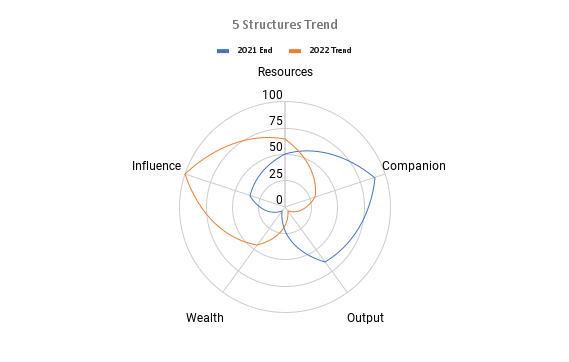
The Five Structures is a profiling system I learned in November 2021. The most interesting thing for me is that the five structures annual chart shows how my personal development will be like in the year.
The year of 2021 is almost ending. When I look back my personal development and skills upgrading with the five structures trend, I have to say it’s quite matching. It’s a year full of challenges for me in many perspectives. I call it a REFLECTION year – I do underground work or prepare for the coming years. In this year I stretched myself quite a lot in certain areas, like companion – connecting new people and seeking my tribes.
I have achieved two things in this structure. First, I have connected some important people for my future, which laid a solid foundation for my transformation in the coming years. Second, a plan for expanding my social connection is in place for 2022 (I will put some effort to execute).
I had quite some struggle in wealth, due to some factors partly influenced by the pandemic (I couldn’t easily travel back China to solve it). Luckily I got support from my family in China. It helped me to carry on my project initiated one year ago. Till today I have found the clarity of my path.
I appreciate that 2021 allowed me to meet important people, to learn from great mentors and peers and to reflect my values and life path.
I look forward to the year of 2022 because it looks prosperous and hopeful from my five structures trend. The chart on the top shows that the trend of 2022 switches the direction and the potentials of my upgrading.
In the coming year I have the potential to influence others and my field very well if I follow my path. I will have fulfilment by serving others as a supporter. I am able to bridge more people and business between the east and the west by providing resources and contacts. It sounds great, right?
Last, I would say 2022 will be transformation in action.
—-
P.S.
If you want to learn about your five structures in 2022, please send me a message by the contact form.



 Grace Coaching & Consulting